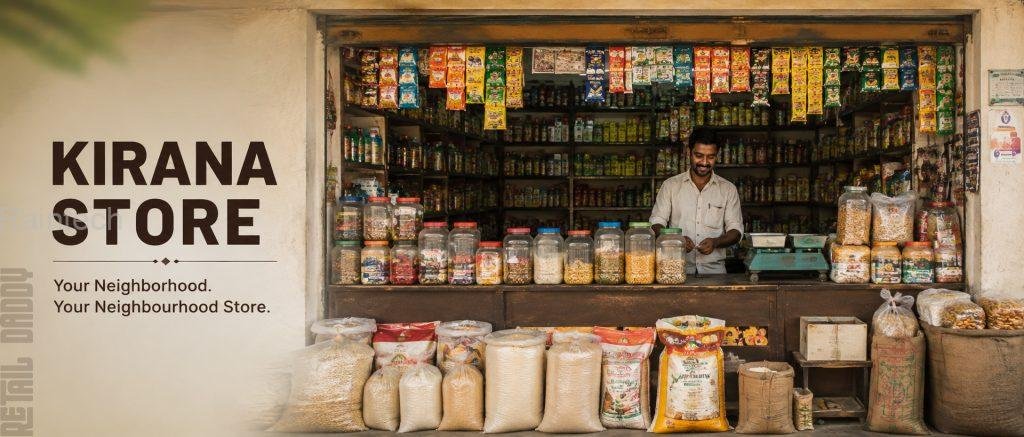
Billing Software for Kirana Stores in Malappuram: Features & Pricing Compared
Retail Daddy Billing Software is our own product. Raintech Software Limited, Kochi, publishes this blog, and we have placed our software first in this comparison. So that you can judge whether that placement is fair, we publish the six scoring criteria before the ranking, and we include a section on the shops Retail Daddy is wrong for. Prices verified [CONFIRM — VERIFY DATE].
It is nine at night in the last week of Ramadan, and the provision store near the bus stand in Manjeri has four people waiting. The man at the front wants two and a half kilos of dates weighed out and his month’s account brought up to date. Behind him a woman holds a packet of matta rice that went up two rupees a kilo on Monday. The delivery boy is at the door with three slips in his hand, waiting to be told which of them have been paid.
The machine has been running since six in the morning. The power dipped twice during the evening.
That is the real test. Not the demo. Not the feature grid on a vendor’s website — that evening, at that counter, with that queue.
This comparison of billing software for kirana stores in Malappuram covers ten products: what each one costs, what each does at a counter like that one, and how to work out which is right for the shop you actually run.
| Which billing software is best for a kirana store in Malappuram?For most shops in the district, two things decide it: whether billing continues during a power cut, and whether the weighing scale is properly wired into the software rather than bolted on. Retail Daddy, Marg ERP and Vyapar handle both. Shop size and budget then separate them — under 400 sq ft, cost matters more than depth. |
Six things worth knowing before you buy
- Published entry prices in this market run from roughly ?399 a year at the low end to about ?22,500 one-time for a single-user TallyPrime licence, verified August 2026. The gap is real, and so is what you get for it.
- Software cost is rarely the biggest number. A working counter — scanner, thermal printer, label-printing scale, UPS — lands somewhere between ?18,000 and ?55,000 depending on how much of it you already own.
- Loose-weight billing is where most cheap software falls over. If you sell matta rice, dal and coconut oil by weight, test this in the demo before anything else.
- Roughly half the products here are cloud-only. In a district that loses power through the monsoon, that is a design decision you have to be comfortable with.
- Credit — kadam, the running household account — is the feature people underestimate and then regret. Ask specifically about part-payments spread across several old bills.
- Nobody publishes an honest support answer for Malappuram. Ask each vendor to name the town their nearest engineer works from. The answers vary a great deal
Why billing software for kirana stores in Malappuram is a different problem
Most national billing software is designed against an imagined shop: fixed MRP products, barcodes on everything, cash or UPI at the till, a stable internet line. A palacharakku kada — the everyday provision shop — matches almost none of that.
Start with the calendar. Kerala content defaults to Onam, and Onam is genuinely large here too. But in Malappuram the Ramadan-to-Perunnal cycle is the peak most shops actually plan stock against: dates, ghee, rice, dry fruit, sherbet concentrate, snacks, moving in household quantities through long evening queues after iftar. Bakrid brings a shorter, sharper spike. Vishu in April is moderate. June school reopening adds a broad restocking week. A shop in Tirur or Ponnani may see four distinct peaks in a year, each with a different basket.
Then the power. Through June to August the supply is not reliable enough to bet a day’s trading on. Feeder trips, brief dips, and long humid afternoons that curl thermal paper on the roll. Software that stops when the connection drops is not a small inconvenience here — it means a handwritten bill book comes out, and the stock figures are wrong for a week afterwards.
The product mix is the third difference. A single bill routinely mixes loose, unbranded staples with pre-packaged and labelled goods. Those two categories are not taxed the same way, which makes an ordinary evening bill a small GST classification exercise. Add dry fish sold by weight, coconut oil drawn from a bulk tin, and rice rates that move weekly, and you have a workflow no invoice-first product was built for.
Fourth, credit. Household accounts run through the month and clear at salary time, or when a remittance lands. Part-payments against several old bills are normal. A shop in Kondotty or Vengara may carry a meaningful share of a month’s turnover on the ledger at any moment.
And language. Owners usually read English. The person at the till often does not. Interface language and printed statement language are separate questions, and both matter more than vendors assume.
Ten things kirana billing software must actually do
Use this as a demo checklist. The test in brackets is what to ask the salesperson to do in front of you, on their machine, before you sign anything.
- Bill by weight, directly from the scale. [Ask them to weigh something, print the bill, then change the per-kilo rate and re-weigh it.]
- Keep billing when the internet drops. [Ask them to switch off the Wi-Fi mid-bill and finish the sale.]
- Recover cleanly from a power cut. [Ask what happens to a half-entered bill if the machine dies. Make them show you.]
- Handle a mixed exempt and taxable basket on one bill. [Loose rice plus a packed rice bag. Check the tax lines.]
- Track credit per customer with a limit and an ageing view. [Ask for a customer with four unpaid bills, then pay ?500 against them.]
- Print in Malayalam, or at least print a customer statement your customers can read. [Ask for a printed sample, not a screenshot.]
- Manage batch and expiry for the short-shelf-life lines. [Ask for the near-expiry report.]
- Run schemes and free-item offers without manual price overrides. [Buy-two-get-one on a soap pack.]
- Add a second temporary counter during a festival week. [Ask the licence cost for that, in rupees, on the spot.]
- Give you a day-close figure you trust. [Cash, UPI, card, credit given, credit collected — on one screen.]
How we ranked these ten
These weights are chosen for one specific buyer: a kirana, grocery or provision store in Malappuram district. They are not general-purpose weights. A garment shop in Kozhikode or a pharmacy in Perinthalmanna would weight them differently, and would probably get a different order.
| Criterion | Weight | Why it carries this weight here |
| Offline reliability | 25% | Monsoon supply interruptions make this the difference between billing and not billing. |
| Loose weight and scale handling | 20% | A large share of daily lines are sold by weight. Software that treats this as an edge case is unusable. |
| Credit (kadam) ledger depth | 15% | Month-end household accounts are working capital, not a convenience feature. |
| GST correctness for grocery | 15% | Exempt and 5% goods share a bill constantly. Errors compound across thousands of transactions. |
| Support reachable in Malappuram | 15% | A Saturday-evening printer failure needs a person, not a ticket number. |
| Three-year total cost | 10% | Licence plus AMC plus per-counter plus hardware — not the headline price. |
What we did not test: we did not run all ten products side by side in a live shop for a full month, and we did not audit anyone’s uptime claims. Offline behaviour, scale support and pricing were assessed from vendor documentation and public pricing pages as they stood in August 2026, plus published user reviews. Where a claim comes from a vendor rather than from our own use, we say so in the write-up.
The ten compared at a glance
| Product | Best for | Offline | Scale | Credit | Malayalam | Price band (Aug 2026) |
| 1. Retail Daddy | Counter shops to mini supermarkets | Yes, offline-first | Yes | Full ledger | [CONFIRM] | [CONFIRM] |
| 2. Marg ERP | Stock-heavy provision stores | Yes, desktop | Yes | Deep | Limited | ?9,000–18,000 one-time + AMC |
| 3. Vyapar | First-time buyers, small shops | Yes, desktop | Basic | Good | Partial | ?3,400–4,000 / year |
| 4. myBillBook | Lowest entry cost, mobile | Partial | Basic | Good | Partial | From about ?399 / year |
| 5. TallyPrime | Accounting and filing depth | Yes, desktop | Add-on | Deep | Limited | Silver about ?22,500 + GST |
| 6. Gofrugal | Multi-counter self-service stores | Hybrid | Yes | Good | Limited | Quote only |
| 7. Zoho | Owners also selling online | Cloud-first | Limited | Good | No | Published SaaS tiers |
| 8. PosBytz | Modern cloud POS, delivery | Cloud-first | Limited | Basic | No | Subscription, quote |
| 9. Regional Kerala vendors | Face-to-face support, custom work | Usually yes | Usually yes | Varies | Often yes | Dealer quote |
| 10. Low-cost tier | Very small shops, tight budget | Yes | Limited | Basic | Rare | From about ?799 / year |
Price bands are as published by each vendor or listed on review platforms in August 2026. Re-check before you buy. Indian software pricing moves.
1. Retail Daddy Billing Software
Our own product, ranked first on the criteria above — mainly on the top two, which together carry 45% of the weight.
Retail Daddy is an offline-first desktop billing product. The billing data lives on the machine in the shop, not on a server somewhere else, and the software does not need a connection to make a sale. That architecture is unfashionable. It is also the single reason we weight offline reliability at a quarter of the score for this district: a shop in Nilambur or Areekode that loses supply for two hours on a Tuesday afternoon can carry on billing, and the stock ledger stays correct afterwards.
At the counter, the workflow is built around the two things a provision store does constantly. Weighing scale input feeds straight into the bill line, so loose rice, dal, sugar and oil are billed by weight rather than typed in as a value. Barcode scanning covers the packed FMCG side, and pre-packed items can be labelled in-house using Barcode Daddy, our label product, which shares the same item master. Rate changes on loose lines apply from the item record without re-entering the product.
The credit side carries a per-customer ledger with limits, an ageing view, and part-payment against multiple outstanding bills — the pattern that actually happens when a household clears its kadam at month-end. [CONFIRM: whether WhatsApp statement sending is included in the base licence or costs extra.]
On support: we are a Kerala company, based in Kochi, working through a dealer and service partner network across the state. [CONFIRM: which Malappuram towns have a partner presence, and what the stated response commitment is. Do not publish a claim here we cannot stand behind.]
Pricing: [CONFIRM — current published band, whether one-time or annual, per-counter cost, AMC, and GST treatment.] The licensing model matters as much as the number, because a second festival-week counter should not cost the same as a second permanent shop.
Where Retail Daddy is the wrong choice
Two situations, plainly.
If you need your books, your GST returns and your billing to be one system your chartered accountant works in directly, TallyPrime is a better fit than we are. We are a billing and retail operations product with reports that export to accounting — not an accounting package. Shops with a serious audit or filing workload should weigh that.
If you are running a genuine multi-counter self-service store — four tills, scheme-driven pricing, loyalty running across branches — Gofrugal is built for that scale in a way we are not yet. A 2,000 sq ft store in Kondotty growing towards a small chain should look there before us.
There is also a third, smaller thing: if your billing has to happen on a phone while you walk the aisle, we are a desktop product first. Vyapar and myBillBook do mobile better.
2. Marg ERP
The strongest inventory brain in this list for a provision store.
Marg has been in Indian distribution and retail for a long time, and it shows in the stock logic — batch handling, scheme management, supplier ledgers, purchase workflows that assume you are buying from a dozen distributors rather than one. For a wholesale-cum-retail shop in Tirur or Edappal moving goods in both directions, that depth is genuine and hard to replace.
Licensing is one-time rather than subscription, roughly ?9,000 to ?18,000 depending on edition as quoted by the vendor and its resellers in August 2026, plus an annual maintenance charge. The reseller network across Kerala is large, which usually means someone local will come out.
The weak spot is the learning curve. The interface carries two decades of accumulated features, and a first-time software buyer with a 300 sq ft shop will find it heavy going for the first month. Staff turnover makes that worse — every new person has to be taught.
Choose Marg if your stock is complicated and you have someone patient enough to learn it properly.
3. Vyapar
The easiest start of anything here, and it knows this market.
Vyapar markets directly to Kerala shopkeepers and names kirana shops in this district on its own state page — worth acknowledging rather than pretending otherwise. The desktop and mobile combination works well for an owner who wants to check figures from home, and the setup can genuinely be done in an afternoon without a technician.
The published desktop-plus-mobile bundle sat in the ?3,400 to ?4,000 a year band on the vendor’s pricing page in August 2026, which is fair for what it does.
Where it thins out is depth. Heavy loose-weight workflows, multi-counter billing and scheme-driven grocery pricing push past what it was designed for. It is a billing and small-business accounting product that suits a grocery shop, rather than a grocery product.
Choose Vyapar if you are moving off a bill book, want to be running this week, and your shop is under about 600 sq ft.
4. myBillBook
Cheapest credible entry point in the list.
Entry plans have been quoted from around ?399 a year on review platforms including G2 and Capterra, with higher tiers listed nearer ?199 a month. For a Parappanangadi or Tanur shop testing whether software helps at all, that is a small enough bet to just make.
It is mobile-first and quick to learn, and GST invoicing is handled properly. Stock tracking and payment follow-up are solid for the price.
Two cautions. Desktop depth is limited compared with Marg or Tally, so a growing store outgrows it. And support responsiveness is a recurring theme in public reviews on G2 and Capterra — several reviewers describe long resolution times. We have not verified that ourselves; we report it because it appears often enough to be worth your asking about directly.
Choose myBillBook if budget is the binding constraint and your stock is simple.
5. TallyPrime
Not really a competitor to the others. A different category that shops keep buying anyway.
Every accountant in Kerala knows Tally, which is the actual reason it sells. Statutory depth, GST return preparation and audit-ready books are unmatched in this list. Silver, the single-user perpetual licence, was around ?22,500 plus GST on the vendor’s pricing page in August 2026 — one payment, no subscription, which some owners strongly prefer.
For a busy grocery counter it is the wrong shape. It is an accounting product with billing attached, not a till. Fast scan-and-weigh billing during a Ramadan evening queue is not what it was designed around, and getting there usually means add-ons or a separate POS front end.
Choose Tally if your accountant runs your business numbers and billing volume is moderate. Pair it with something else if it is not.
6. Gofrugal
Supermarket-grade retail POS, and priced accordingly.
This is the product on the list built for multiple counters, express lanes, scheme engines and loyalty running across branches. If you have grown from a kada into a 2,000 sq ft self-service store — the trajectory a lot of shops in Kondotty and Valanchery have followed — Gofrugal handles that shape properly.
Pricing is quote-based. There is no public per-shop number, and we will not invent one. Expect the conversation to start with a sales call rather than a price page, which small buyers find frustrating.
For a single-counter shop it is more product than the problem needs, and the cost reflects a customer profile larger than yours.
Choose Gofrugal if you are running three or more tills, or expect to be within two years.
7. Zoho (Books / Billing)
Clean, well-built, cloud-first — and built around invoices rather than a retail till.
Zoho’s advantage is the ecosystem. If you also sell online, run a delivery operation, or want your billing connected to inventory and accounting in one account, few Indian products do that as tidily. Pricing is published in tiers, with a free level for very small turnover, which is unusually transparent for this market.
The trade-off is workflow and connectivity. It thinks in invoices and customers, not in a scan-weigh-print rhythm at a counter with six people waiting. And it needs the internet. For a Wandoor or Melattur shop where the line is not dependable, that is a real constraint rather than a theoretical one.
Choose Zoho if your business has an online side and your connection is solid.
8. PosBytz
Modern cloud POS with online-ordering ambitions.
The product is well designed and aimed at retailers who want a storefront, delivery and a till running off the same system. For a store adding home delivery as a real revenue line, that integration is the draw.
Two reservations for this specific buyer. Grocery depth — loose weight, batch, scheme handling — is thinner than the specialists above. And the Kerala support footprint is smaller than Marg’s or Tally’s, which matters most on the day something breaks. [CONFIRM current positioning before publishing; this is a fast-moving product.]
Choose PosBytz if online ordering is central to your plan and your shop is not weight-heavy.
9. Regional Kerala vendors
A category rather than a product, and one this district uses more than the national listicles admit.
Softland India and a number of smaller Kerala software houses sell directly to shops here, often through a local dealer who will sit at your counter and configure the item master with you. Malayalam interfaces and printed statements are more common than with national products. Customisation is possible in a way it simply is not with Tally or Zoho. A Justdial search for the district returns dozens of these firms, several quoting from around ?2,500 to ?3,000 for a package.
The risks are real too. Product roadmaps vary. Pricing transparency depends on which dealer you get. If the firm is small, your continuity depends on a handful of people staying in business.
Choose a regional vendor if face-to-face support and Malayalam matter more to you than a long product roadmap — and ask how many shops they currently support in your taluk.
10. The low-cost tier: Hitech BillSoft, Accountune and similar
Honest about what they are, which is more than can be said for some.
Accountune publishes at ?799 a year openly on its own site, verified August 2026. Products in this tier do GST billing, basic stock and simple reports, and they do not pretend to be more. For a pettikada in Areekode turning over modest volumes, that may be the entire requirement.
The ceiling arrives quickly, though. Inventory depth is limited, weighing-scale support is patchy, support is usually email or a phone queue, and there is rarely anyone to visit. Most shops that grow past a single counter replace these within two or three years.
Choose this tier if you need a legal GST bill and a stock count, nothing more, and you are comfortable switching later.
How much does billing software cost for a small grocery shop?
Between roughly ?399 a year and ?22,500 once, for the software alone, based on published prices in August 2026. That range is wide because the products are genuinely different, not because anyone is overcharging.
| Product | Model | Entry band (Aug 2026) | What is extra | Notes |
| Retail Daddy | [CONFIRM] | [CONFIRM] | [CONFIRM: per-counter, AMC] | Offline-first desktop |
| Marg ERP | One-time + AMC | ?9,000–18,000 | Annual AMC, extra users | Edition-dependent |
| Vyapar | Annual | ?3,400–4,000 / yr | Extra devices | Desktop + mobile bundle |
| myBillBook | Annual / monthly | From about ?399 / yr | Higher tiers, extra users | Tier listings vary by platform |
| TallyPrime | One-time perpetual | Silver about ?22,500 + GST | Gold multi-user, TSS renewal | Accounting-first |
| Gofrugal | Subscription / licence | Quote only | Modules, counters | No public per-shop price |
| Zoho | Monthly / annual SaaS | Published tiers | Add-on apps, users | Free tier for small turnover |
| PosBytz | Subscription | Quote | Modules | Verify current tiers |
| Regional vendors | Dealer quote | Often ?2,500–3,000+ | AMC, customisation | Varies widely by dealer |
| Low-cost tier | Annual | From about ?799 / yr | Little — that is the point | Accountune publishes openly |
Prices verified [CONFIRM — VERIFY DATE]. Bands are as published by each vendor or listed on review platforms; where a vendor quotes only on request, we have said so rather than estimating.
The four costs people forget
Annual maintenance. One-time licences usually carry an AMC of somewhere between 15% and 20% of licence value per year for updates and support. Skip it and you eventually cannot get help.
Per-counter licensing. The second till during Ramadan week is often a second licence. Ask the price before you need it, not during the rush.
GST on the software. Software attracts GST like anything else. A quoted price may or may not include it, and 18% on ?22,500 is not a rounding error.
Hardware. Frequently larger than the software cost in year one. Which brings us to the next table.
What hardware do I need for a billing counter?
These are indicative Kerala market bands, not quotes. Prices depend on brand, warranty and which dealer you buy from — and a Perinthalmanna dealer may quote differently from one in Kochi.
| Item | Indicative band | Notes |
| Handheld barcode scanner | ?1,200–4,000 | Wired 1D is enough for grocery. Wireless costs more and gets lost. |
| Thermal printer, 2-inch | ?2,500–5,000 | Fine for a short bill. Narrow for a 30-line grocery bill. |
| Thermal printer, 3-inch | ?5,000–9,000 | Better for long bills and readable rate columns. |
| Counter weighing scale | ?2,500–6,000 | Weighs only. Someone still types the number. |
| Label-printing weighing scale | ?18,000–35,000 | Prints a price-embedded barcode. Changes the whole workflow. |
| Cash drawer | ?2,000–4,500 | Skippable at first. Useful once staff handle cash. |
| UPS | ?2,500–6,000 | Not optional in this district. Buy for runtime, not price. |
| Computer or POS terminal | ?18,000–45,000 | A basic desktop is enough for single-counter billing. |
A minimum viable counter — scanner, 2-inch printer, counter scale, UPS, on a computer you already own — lands near ?9,000 to ?18,000. A full self-service setup with a label-printing scale, 3-inch printer, drawer and a new terminal runs closer to ?45,000 to ?55,000. Most shops start at the first number and grow into the second.
Four features worth understanding before the demo
Does billing software connect to a weighing scale?
Yes, but the word “connect” hides two completely different setups, and buying the wrong one is the most common expensive mistake in this category.
The first is a counter scale wired to the billing machine by serial or USB. You place the rice on the scale, the weight appears in the bill line, the software multiplies by the per-kilo rate. Cheap, quick, and the staff member still has to select the right item first. For a shop selling ten or twelve loose lines, this is usually enough.
The second is a label-printing scale sitting away from the till, often near where goods are pre-packed. It weighs, prints a sticker carrying a price-embedded barcode, and the till simply scans that sticker. The barcode holds the item code and the price or weight together. This is how a self-service store handles loose goods without a queue forming at the scale, and it is the setup a store in Kottakkal or Ponnani moving towards self-service will eventually need.
Three details that decide whether either works properly. Tare: the software must subtract the container or bag weight without arithmetic at the counter. Rate changes: when matta rice moves two rupees, you should update one item record, not every open bill. And rounding — per-kilo against per-100-gram pricing produces different paise, and inconsistent rounding across a thousand bills a week is money.
Ask which scale brands and models the vendor has actually tested. “Any scale with a serial port” is not an answer. [CONFIRM: Retail Daddy’s tested scale list.]
Can I track customer credit in billing software?
Every product here says yes. What separates them is how they handle the messy version, which is the only version that happens.
| Capability | Why it matters at a kirana counter |
| Per-customer credit limit | Stops the ledger growing quietly. The software should warn at the till, not in a report next month. |
| Ageing view | Thirty, sixty and ninety days separated. Without it, everything looks equally recoverable. |
| Part-payment across bills | A household pays ?2,000 against six old bills. The software must allocate it, not force one bill at a time. |
| Month-end statement | One printed sheet per household, in a language they read. This is what actually gets accounts settled. |
| Reminder sending | WhatsApp beats a phone call. Malayalam beats English. Ask whether it costs extra. |
| Credit given vs collected | Both numbers on the day-close screen. One without the other tells you nothing. |
One practical note that a sales demo will never cover: the delivery boy problem. Goods go out, a slip comes back, payment arrives later and separately. If your software cannot record a bill as delivered-and-unpaid without either forcing a cash entry or leaving the bill open indefinitely, that gap will show up in your figures every month. A shop in Tirurangadi running three delivery rounds a day will notice it inside a week.
Expiry, batch and damaged stock
Grocery has a quiet loss problem that shows up as a stock difference nobody can explain. Handle it in this order.
- Decide which lines need batch tracking. Not all of them do. Bread, milk, curd, packaged snacks and anything with a printed date — yes. Rice and dal by weight — usually not.
- Enter expiry at purchase, not at sale. If it is not captured when goods come in, it will never be captured at all.
- Set the software to pick oldest-first at billing. First expired, first out. If staff can override this, they will.
- Run the near-expiry report weekly, on a fixed day. Monday morning works because you can still discount before the weekend.
- Record damage and returns as their own transaction type. Written off in a stock adjustment, they vanish. Recorded properly, you find out which supplier keeps sending short-dated stock.
- Reconcile monthly against a physical count of your top fifty lines. Not everything. Fifty is enough to catch a pattern.
Shops that do this find their unexplained loss falls noticeably within a quarter. We are not going to put a percentage on it, because the honest answer is that it depends entirely on what your shop was doing before.
Can billing software work without internet?
Some can. The claim is on nearly every website, so here is how to tell the difference.
Does billing continue with the connection down?
In a true offline product the answer is yes, because the database is on the machine. In a cloud product with an offline mode, the answer is usually yes for a limited window, holding transactions locally until the line returns.
Does stock deduct while offline?
This is the question that separates them. Some products keep billing but stop updating stock, which means your inventory is wrong for as long as the outage lasts and nobody notices until the count.
What happens to a half-entered bill when the power cuts?
Ask for a demonstration. Pull the plug on their machine. A well-built product recovers the bill or discards it cleanly; a poorly built one leaves an orphan record that corrupts the day-close figure. A UPS makes this rare, not impossible.
How does it reconcile afterwards?
Queued transactions should sync in order, without duplicates, without asking the shopkeeper to resolve conflicts. Ask what happens if two counters both billed the last unit of an item while offline.
GST for kirana stores, without the jargon
The distinction that matters most in a provision shop is not the rate table. It is packaging.
Loose, unbranded staples sold from a sack or tin are generally exempt. The same goods, pre-packaged and labelled, generally attract 5%. That single line separates the rice you scoop into a bag from the rice you sell in a printed one-kilo pack, and it is the most common classification error at an Indian grocery counter. The definitions come from the Legal Metrology (Packaged Commodities) Rules rather than from GST law itself, which is why they catch people out.
The September 2025 rate rationalisation moved India to a principal structure of 0%, 5% and 18%, with a separate high band applied to a narrow set of goods, and dropped several everyday food items to nil. Packaged food sits mostly at 5%; several dairy and bread items moved to zero.
| Category | Typical treatment | Example at your counter |
| Loose unbranded staples | Generally exempt | Rice weighed from a sack, loose dal, loose sugar |
| Pre-packaged and labelled | Generally 5% | Branded one-kilo rice pack, packed atta |
| Packaged snacks and confectionery | Generally 5% | Namkeen packets, biscuits, chocolate |
| Fresh produce | Generally exempt | Vegetables, fresh fruit |
| Several dairy and bread items | Nil after Sept 2025 | UHT milk, pre-packaged paneer, roti and paratha |
| Standard goods | Generally 18% | Cleaning products, many non-food lines |
Classification is item-specific and changes by notification. Treat this table as orientation, check the current rate for your actual lines against the CBIC notifications, and have your CA confirm the edge cases. Getting a rate wrong on a fast-moving line for a year is expensive in a way that is tedious to unwind.
Do I need GST registration for my kirana store?
For goods, registration becomes mandatory above ?40 lakh annual turnover in most states, Kerala included. Below that you may register voluntarily, and many shops do because suppliers prefer it. The composition scheme is available to small businesses at a lower flat rate with simpler returns, but it blocks input tax credit and inter-state supply. For a single shop buying locally and selling to households, that trade is often worth it. For anyone buying from out-of-state distributors, usually not.
Find your shop type
Counter shop or pettikada, under 300 sq ft
Packed goods, a short list of loose lines, one person at the till. You need a legal GST bill, a stock count and a credit ledger. Start with myBillBook or the low-cost tier and upgrade when it hurts.
Neighbourhood palacharakku kada
Heavy loose-weight trade, a real credit book, one counter that gets busy at 7pm. This is the profile Retail Daddy is built around. Vyapar is the alternative if budget is tight and your stock is simple.
Self-service mini supermarket, 1,000 sq ft and up
Two counters, a label-printing scale, schemes and offers. Retail Daddy or Gofrugal, depending on whether you expect a third and fourth till.
Wholesale-cum-retail provision store
Bulk and retail on the same premises, many suppliers, complex purchase workflows. Marg ERP earns its learning curve here.
Store running home delivery
Bills leaving the shop before payment does. You need delivered-unpaid as a real status. Retail Daddy or PosBytz, depending on whether you also want online ordering.
Owner with two or more branches
Consolidated stock and a single item master matter more than counter speed. Gofrugal or Marg, and be prepared to pay per location.
Store adding a bakery or tea counter
You have crossed into food service, where GST works differently and a kitchen order flow appears. A retail product plus a restaurant billing product, rather than forcing one to do both.
Buying it without regretting it
Five mistakes shops make
- Buying on the headline price. A ?3,400 licence with a ?22,000 scale you did not budget for is not a cheap year.
- Skipping the item master. Two days of proper data entry at the start saves an hour a week forever. Shops that rush this abandon the software within three months.
- Not asking about the second counter until the festival week. Then paying whatever is asked, under pressure.
- Choosing cloud without checking the line. Test your actual connection at 7pm on a Saturday, not at 11am on a Tuesday.
- Training only the owner. The person who bills is usually not the person who bought. Train whoever stands at the till, and train the relief person too.
Twelve questions to ask in the demo
Read these off your phone. Make them answer on their machine, not in a brochure.
- Switch the internet off and complete a bill for me.
- Weigh something, print it, then change the rate and weigh it again.
- Show me a bill with one exempt item and one 5% item on it.
- Take ?500 against four old unpaid bills for one customer.
- Print a month-end customer statement. On paper.
- Show me the near-expiry report.
- Run a buy-two-get-one offer without typing a manual discount.
- What does a second counter cost, in rupees, today?
- Which weighing scale models have you actually tested?
- If I stop paying you, what happens to my data?
Moving from what you use now
From a bill book: the work is the item master, not the software. Budget two days to enter your top 300 lines with rates, tax and barcodes. Everything after that is fast.
From Excel: most products import a spreadsheet if the columns are clean. Item name, code, rate, tax and opening stock as separate columns, no merged cells, no headings mid-sheet. Expect to fix a hundred rows by hand.
From older software: item masters and customer lists usually transfer. Transaction history usually does not, or does so poorly. Plan to run both for one month, close the old system at a month end, and keep a readable export of the old data for at least three years for tax purposes.
Frequently asked questions
Is billing software mandatory for a kirana store?
No. Billing software is not legally required. What is required, if you are GST-registered, is a compliant tax invoice with the prescribed particulars and sequential numbering. A handwritten bill book can meet that. Software is a practical choice about speed, stock accuracy and credit control — not a compliance obligation in itself.
How do I bill loose rice in billing software?
Set the item up with a per-kilogram rate and a weight-based unit, then either take the weight directly from a connected scale or scan a sticker from a label-printing scale. Avoid typing values manually — that is where errors and staff-side leakage start. Make sure tare is handled by the software.
What is the best free billing software for a grocery shop?
Free tiers exist, including from Zoho for very small turnover and from several open-source and lite products. They generally cap invoice counts, users or features, and rarely support weighing scales. For a shop selling by weight, a paid product from around ?399 to ?800 a year is usually the more sensible starting point.
How long does it take to set up billing software in a shop?
Installation takes under an hour. Entering your item master properly takes one to three days depending on how many lines you carry. Most shops bill in parallel with the old book for the first week. Plan a fortnight before you fully trust the stock figures.
Which billing software works in Malayalam?
Regional Kerala vendors most consistently offer Malayalam interfaces and printed statements. Among national products, Malayalam support is partial and often limited to printing rather than the full interface. Ask for a printed Malayalam bill and a Malayalam customer statement in the demo. [CONFIRM: Retail Daddy Malayalam coverage.]
Can I use billing software on a mobile phone?
Yes, for several products. Vyapar and myBillBook are strong on mobile, and cloud products run in a browser. For a busy counter with a scanner, a printer and a scale attached, a desktop remains faster. Many owners run desktop at the till and mobile for checking figures from home.
What happens to my data if I stop paying?
It depends on the licensing model, and you should ask before buying rather than after. Perpetual desktop licences generally keep working without updates. Subscription products typically restrict access at expiry, though most allow an export. Get the answer in writing.
Do I need a barcode scanner for a kirana shop?
Only if a meaningful share of your goods carry barcodes already. If you mostly sell loose and locally packed goods, a scale matters far more than a scanner. Many shops buy the scanner first because it feels like the obvious step, then find it barely gets used.
Can two people bill at the same time?
Only with multi-counter support and usually an additional licence per counter. This becomes a live question during Ramadan and Onam weeks when a temporary second till appears. Ask the price before the season, not during it.
Will billing software help me recover old credit?
Indirectly. It will tell you exactly who owes what and for how long, and it will print a statement your customer can read. Collection is still a conversation. Shops report that a printed ageing statement changes that conversation more than a phone call does.
Is cloud or offline better for a shop in Malappuram?
Offline or hybrid, for most shops here, because of monsoon supply interruptions. Cloud makes sense if you have a dependable connection and want branch consolidation or online sales. Hybrid — local billing with background sync — is the reasonable middle position.
Should I buy from a local dealer or directly from the vendor?
A local dealer costs a little more and is worth it for a first-time buyer, because setup help and on-site support matter most in the first three months. Buy direct if you are technically confident or replacing software you already understand.
Where to start
If you run a counter shop under 300 sq ft, start cheap and prove the habit before you spend. If you sell heavily by weight and carry a real credit book, weighting offline reliability and scale handling the way we have will point you at Retail Daddy or Marg. If your stock is complicated and you buy from many distributors, Marg’s learning curve pays for itself. If you have three tills and are growing, look at Gofrugal instead of forcing a smaller product upwards. And if your accountant runs your numbers, buy Tally for the books and something else for the counter.
Leave a Reply