Billing Software in Karnataka: What Actually Works at the Counter
| Level | What it means | What can still break |
| Level 0 | Cloud-only operation | Billing stops when the connection stops. |
| Level 1 | Offline invoice capture | Full catalogue, historical bills, reports and some barcode functions may be unavailable. |
| Level 2 | Offline operation with cloud master | Caches can become stale; sync and multi-counter issues can appear. |
| Level 3 | Offline-first local database | Core billing works locally; cloud is used for backup and optional sync. |
What Cannot Truly Be Completed Offline
E-invoice IRN generation ultimately requires communication with the Invoice Registration Portal.
E-way bill generation requires the relevant government portal connection.
GST return submission requires the GST portal, even if data can be prepared offline.
Cloud backup and live multi-branch consolidation require connectivity.
A UPI QR can be displayed or printed offline, but confirmation that payment was received is not an offline function.
How We Scored the Software
| Weight | Criterion | What matters |
| 30% | Billing and offline depth | Catalogue, barcode, reports, reprints and core billing without internet. |
| 20% | Data ownership and recovery | Local database, backup and restore process. |
| 20% | Three-year total cost | Licence, AMC and additional-counter cost. |
| 10% | GST handling | Correct GST computation and honest portal dependency. |
| 10% | Power-event resilience | Recovery after shutdowns and interrupted bills. |
| 10% | Karnataka support reach | Installation, escalation and update support in the state. |
Top 10 Billing Software Options for Karnataka
| Rank | Software | Best fit | Key strength | Main limitation |
| 1 | Retail Daddy | Independent retail, supermarkets, 1–3 counters | Retail-first billing, local data, offline capability and vertical modules | Karnataka-specific support reach should be confirmed |
| 2 | Marg ERP | Distribution, pharmacy, trading | Deep inventory, distribution and pharmaceutical workflows | Dated interface and steeper learning curve |
| 3 | TallyPrime | Accounting-led businesses | Strong accounting ecosystem and GST workflows | Accounting-first rather than counter-first |
| 4 | BUSY Accounting | Trading and wholesale | Strong accounting and local database operation | Less retail-counter focused |
| 5 | Hitech BillSoft | Small single-counter shops | Low-cost offline billing | Less depth for multi-counter and specialist retail |
| 6 | Gofrugal | Growing chains | Multi-outlet stock and central management | Heavier implementation for a small shop |
| 7 | LOGIC ERP | Larger retail and apparel | Enterprise reporting and variant-heavy retail | More complex and quotation-led |
| 8 | Vyapar Desktop | Very small shops | Simple and budget-friendly | Offline catalogue depth and scale limitations |
| 9 | myBillBook | Mobile-first micro businesses | Easy phone-based billing | Can become limiting for high-volume counters |
| 10 | Regional/free billing tools | Very small businesses | Low or zero entry cost | Support, barcode and multi-user limitations |
1. Retail Daddy Billing Software
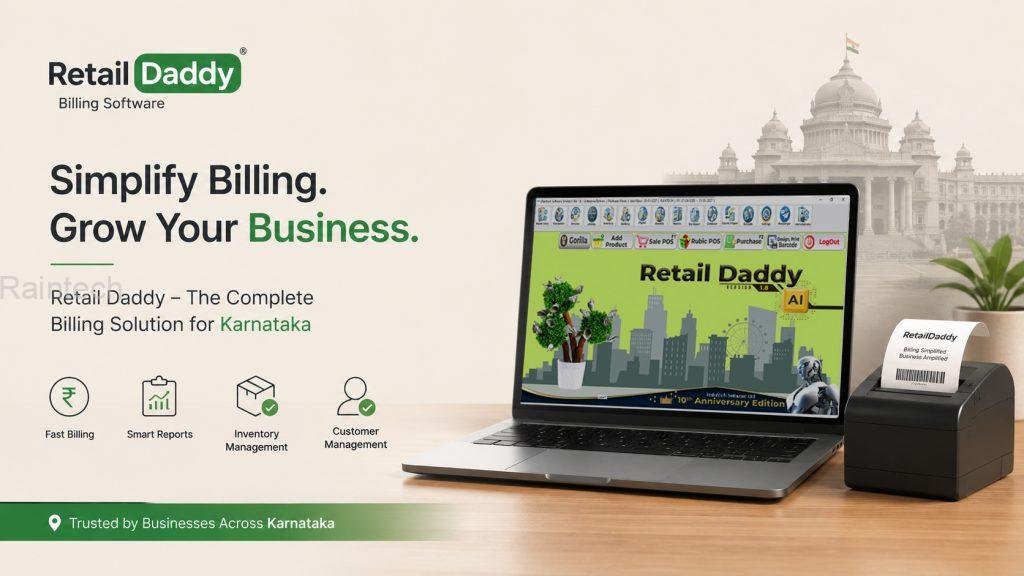
Retail Daddy ranks first in this comparison. The supplied source describes it as a Level 3 offline system with a SQL database on the shop machine. Core functions described include full item-master access, barcode lookup, purchase and sales reports, sales returns and reprints without relying on a live internet connection.
Automatic daily backup to a linked Google account with a restore path.
Barcode design and printing, thermal-printer configuration and label printing.
Weighing-scale integration for supermarket workflows.
Retail-specific modules for pharmacy FIFO/FEFO, electronics IMEI tracking and garment size-and-colour SKUs.
Mobile billing, WhatsApp/SMS integration and OCR-based purchase intake.
Where another option can be better: Marg ERP is stronger for deep distribution and pharmaceutical workflows. For a large chain or highly specialized enterprise setup, Gofrugal or LOGIC ERP may be more appropriate.
2. Marg ERP
Marg ERP is a strong second choice for Karnataka businesses that combine retail with distribution, wholesale, trading or pharmacy. Its local database and mature inventory workflows make it attractive where stock, schemes, claims and batch management are central.
3. TallyPrime
TallyPrime remains a major option for businesses that want billing closely integrated with accounting. Its biggest advantage is the depth of the accounting ecosystem and the availability of accountants and operators already familiar with it. For a very fast barcode-led supermarket counter, however, a retail-first product may feel more natural.
4. BUSY Accounting
BUSY is particularly relevant to wholesalers and traders that need strong accounting, credit management and reporting alongside billing. It is less focused on the scan-print-next-customer workflow of a busy grocery counter.
5. Hitech BillSoft
Hitech BillSoft is positioned as a low-cost Windows billing option for retailers, wholesalers, restaurants and service businesses. Its advantage is affordability; its limitation is the smaller ceiling when additional counters, branches or vertical modules are introduced.
6. Gofrugal
Gofrugal becomes more interesting as the business grows into multiple outlets. Centralized stock control, price management and multi-outlet operations can justify its higher implementation effort for a chain.
7. LOGIC ERP
LOGIC ERP is better suited to larger retail operations, especially apparel and footwear businesses where size, colour and variant matrices become complex. It is more enterprise-oriented than what a small independent shop usually needs.
8. Vyapar Desktop
Vyapar is a straightforward choice for very small businesses that prioritize low cost and ease of getting started. Its offline approach is useful, but catalogue depth and multi-counter requirements should be tested before scaling.
9. myBillBook
myBillBook is a mobile-first option that can suit owners who want to bill from a phone or at delivery points. For a high-volume fixed retail counter, dedicated barcode hardware and desktop workflows may be more efficient.
10. Regional and Free Billing Tools
Local vendors and free billing products can make sense for very small shops, particularly when physical support is the priority. The trade-off is usually less depth in barcode workflows, multi-user operation, specialist modules and long-term support.
Pricing: Compare the Full Cost, Not Just the Licence
The supplied Maharashtra article shows a very wide market price range and warns that licence model, counter count, AMC and hardware can change the real cost. Karnataka buyers should request a written quote that separates these items.
| Cost item | What to ask |
| Software licence | Per user, per counter, annual subscription or perpetual? |
| Additional counters | What is the second and third counter price? |
| AMC / support | Included or charged separately after year one? |
| GST / updates | Are tax updates included? |
| Hardware | PC, printer, scanner, cash drawer and scale included or extra? |
| Backup | Automatic or manual? Where is the backup stored? |
| Migration | What does importing Excel, Tally or an old system cost? |
Typical Billing Counter Hardware
| Hardware | Indicative consideration |
| Billing PC | Prioritize SSD and reliability over unnecessary processor power. |
| Thermal receipt printer | Choose a 2-inch or 3-inch model according to bill length. |
| Barcode scanner | Wired 1D scanning is sufficient for many retail counters. |
| Cash drawer | Printer-triggered drawers simplify the counter workflow. |
| Label-printing weighing scale | Useful for supermarkets and loose goods. |
| UPS | Protects the billing PC and gives time for safe shutdown. |
Five Shop Types, Five Requirements
| Shop type | Important functions | Recommended architecture |
| Kirana / general store | Full catalogue, barcode, loose goods, credit ledger, reprints | Level 3 preferred |
| Supermarket | Multiple counters, shared stock, scales, cashier accountability | Level 3 with local LAN/server |
| Garment shop | Size/colour variants, exchanges, credit notes | Level 3 preferred |
| Hardware / building materials | Large catalogue, units, party rates | Deep local catalogue |
| Wholesale trader | Large invoices, credit ageing, transport details | Accounting + strong inventory |
Why Retail Daddy Ranks First — and When It Should Not
Retail Daddy takes first place because the scoring method gives the greatest weight to actual offline depth, data ownership and recovery, while still considering cost, GST handling, power-event resilience and support. The source material specifically describes its local SQL database, retail modules, barcode functionality and automated backup.
large multi-outlet operations, Gofrugal or LOGIC ERP may be a better fit.
distribution and pharmaceutical-heavy workflows, Marg ERP may be stronger.
accounting-led businesses, TallyPrime or BUSY may offer greater accounting depth.
Frequently Asked Questions
What is billing software?
Billing software creates invoices and manages sales records, GST calculations, inventory and related retail operations. Better systems also handle barcode billing, reports, returns and backups.
Which billing software ranks first in this comparison?
Retail Daddy ranks first based on the scoring method used in this article.
Can billing software work without internet?
Yes. The degree of offline capability varies. A local-database Level 3 system can continue core billing without a live connection.
Can I generate an e-invoice completely offline?
No. The final IRN process requires communication with the relevant government portal.
Which is better for a large retail chain?
Gofrugal or LOGIC ERP can become stronger choices as the number of outlets and central-management requirements grow.
Is TallyPrime good for billing?
Yes, particularly when accounting is a major requirement. It is less specifically designed around a high-speed retail POS workflow.
What should I ask about backups?
Ask where the database is stored, how often backups run, where they are kept and whether the vendor can demonstrate restoring one.
How many counters should I plan for?
Buy according to the busiest period, not the average day. Ask the vendor for the exact second- and third-counter pricing before purchase.
Should I choose cloud or offline billing?
For a single or small number of retail counters, offline-first software can reduce dependence on connectivity. Multi-branch businesses may value cloud consolidation more.
Final Verdict
For a typical Karnataka retail shop looking for a practical combination of billing, barcode support, GST handling, local data ownership and offline resilience, Retail Daddy is the first choice in this comparison. Marg ERP is the stronger alternative when distribution or pharmacy complexity dominates. TallyPrime is the natural choice when accounting is the centre of the operation. The right purchase, however, is the one that survives the demo test with your own products, counters, printers and workflows.
Leave a Reply